Psalm 103:13

As a father has compassion on his children,
so the Lord has compassion on those who fear* him;

*From DSC:
Fear here refers to respect or to revere


Psalm 23:1-3

A psalm of David.
1   The Lord is my shepherd, I lack nothing.
2  He makes me lie down in green pastures,
he leads me beside quiet waters,
3   he refreshes my soul.
He guides me along the right paths
for his name’s sake.

Matthew 7:13-14

The Narrow and Wide Gates
13 “Enter through the narrow gate. For wide is the gate and broad is the road that leads to destruction, and many enter through it. 14 But small is the gate and narrow the road that leads to life, and only a few find it.
.

— as seen originally here


Psalm 103:2-5

2 Praise the Lord, my soul,
and forget not all his benefits—
3 who forgives all your sins
and heals all your diseases,
4 who redeems your life from the pit
and crowns you with love and compassion,
5 who satisfies your desires with good things
so that your youth is renewed like the eagle’s.

Psalm 100:4-5

4 Enter his gates with thanksgiving
and his courts with praise;
give thanks to him and praise his name.
5 For the Lord is good and his love endures forever;
his faithfulness continues through all generations.

Psalm 68:4-5

4 Sing to God, sing in praise of his name,
extol him who rides on the clouds;
rejoice before him—his name is the Lord.
5 A father to the fatherless, a defender of widows,
is God in his holy dwelling.

Proverbs 18:10

The name of the Lord is a fortified tower;
the righteous run to it and are safe.


From DSC:
I used to be able to bring up Firefly on the web and use it “free” of charge — I didn’t have to go purchase tokens or credits. (I was actually paying for the Adobe Creative Cloud Pro suite of tools…so it wasn’t really free.)

But the other day I was trying to figure out what the latest pricing is at Adobe with that suite of tools and the use of credits for AI-based features. They say Adobe Creative Cloud Pro users get 4000 credits a month. Well, I have that suite and I’m still getting prompted to purchase credits. Firefly for individuals runs from $9.99 (2,000 credits/month) to $139.91 per month (50,000 credits per month). Not inexpensive, right? Below are other items along these lines.


The Era of Affordable AI Is Over. What Comes Next? — from builtin.com by Ameya Kanitkar
AI providers are shifting to usage-based billing for their services. AI fluency is more important now than ever to make the most of your tools to avoid unnecessary spending.

Summary: The era of cheap, flat-rate AI is ending as providers shift to usage-based billing. Every prompt now carries a direct cost, turning casual use into major budget risks, as seen when Uber depleted its 2026 AI budget in four months. Leaders must now track real-time value and token efficiency.

For a brief window, companies had access to the most transformative technology in a generation at the cost of a streaming subscription. Tools like ChatGPT put AI within reach of anyone with a browser and time for experimentation, while GitHub Copilot came in at just $10 a month, with token costs remaining relatively low. In the beginning, experimentation felt cost-effective, easy and relatively low-risk. 

But that era is ending, and the bill is coming due faster than a lot of enterprise leaders anticipated. 


The Fable of AI in Education — from downes.ca by Stephen Downes
Marc Watkins, Rhetorica, Jun 17, 2026

Tokenomics will be a hot topic of discussion on university campuses because, as Marc Watkins notes in this article, there is no realistic path forward to providing all students with access to advanced AI.


From this posting on LinkedIn.com from Dr. Nick Jackson:

And now there is a third layer emerging. Institutions are waking up to a systems-level question they are likely not remotely prepared for. Who pays for AI? How are budgets managed when there are unclear token consumption pricing models? How is AI procured? Who decides what tools get used and by whom and who gets access and at what level?

.


What a disco ball teaches us about learning and leadership — from timeshighereducation.com by Lauren Flannery
By acknowledging that perspectives are evolving and relational, educators and leaders can encourage contribution and connection without sacrificing what makes people distinct

It also shows us that difference does not always need to be resolved. In teaching, learning and leadership, the aim is not to create uniformity but to create conditions in which different people can contribute, connect and shine without losing what makes them distinct.

In classrooms, inclusion is sometimes approached as ensuring access to the same knowledge, resources and opportunities for all students. The beach ball helps here: it encourages us to explore multiple perspectives. But the disco ball pushes us further to explore how learning environments can support students to bring their experiences, identities and knowledge into the room – not to smooth them out but to draw from them.

Designing for multiple perspectives also means recognising that expressing an opinion is not only about confidence; it is also about conditions. People are more likely to speak when they feel their contribution will be heard without being dismissed, appropriated or flattened. Creating those conditions may involve discussing uncertainty, welcoming challenge, slowing down decision-making or making space for quieter forms of participation. The aim is not to make everyone agree, but to allow different reflections to interact in ways that generate richer understanding.


From DSC:
Following are several companies that are using AI to connect people to work. That’s a significant piece of my Learning from the Living [AI-Based Class] Room vision.

These companies were listed on an article entitled,
Can AI be an effective career coach?
— from achievepartners.com and Ryan Craig


FutureFit AI
Bridge the gap between talent, training, and employment at scale

AI-powered workforce technology connecting people to careers, employers to talent, and workforce partners to tools for integrated and intelligent workforce systems.

PathPilot AI

Empowering every job seeker with personalized AI coaching. Helping organizations scale career services and improve outcomes.

Empower Students with Career-Ready Skills
Help students discover career pathways, develop essential skills, and connect with opportunities. PathPilot provides personalized guidance that scales across your entire institution.

  • AI-powered career exploration and pathway planning
  • Skills assessment aligned with NACE competencies
  • Resume builder and interview preparation tools
  • Job matching with local and national employers
  • Institutional analytics and outcome tracking
  • Integration with existing career services systems

Pathific — Design your future
The all-in-one platform that connects your strengths to programs, careers, and real salary outcomes — powered by AI.

High school, post-secondary, newcomer to Canada, or career change — Pathific meets you where you are.

Your all-in-one career compass
Quality career guidance shouldn’t depend on where you go to school, when you start your journey, or where you come from. Using the latest AI and comprehensive Canadian data, we built a platform that gives everyone clear, data-driven pathways to their future. No more one-size-fits-all advice. No more guessing. Just your strengths, connected to real data.

OpportuNext

See Where Your Skills Can Take You | Find new career path opportunities with one simple search.

OpportuNext from Signal49 Research is a free-to-use career tool created in partnership with the Future Skills Centre. Using big data, it matches a person’s skills with viable career paths — often including some you have not considered.


If AI Eats the Entry-Level Job, Where Do Young People Learn to Work? (Ryan Craig, Achieve Partners) — from humanistxyz.substack.com by Allison Dulin Salisbury; via Ryan Craig
“The public should not be subsidizing colleges whose students lack relevant, paid, in-field work experience.”

That is the trap at the center of this conversation: everyone wants to hire someone with three years of experience, and almost no one wants to provide those three years.

And Ryan’s policy prescription is unusually concrete: pay employers to hire and train apprentices, following the countries that have scaled apprenticeship far faster than the U.S.; require colleges receiving federal student aid to provide relevant, paid, in-field work experience; and build a market of intermediaries that can make the whole thing operational.

Ryan’s view is that higher education remains critically important. But college without meaningful work experience may become a much worse bet, especially for students who cannot afford to guess wrong.


3 Retrieval Games to Try in Your High School Classroom — from edutopia by Andrew Atherton
These activities make reviewing content fun, so they can really motivate students to cement their learning.

These games can start or end the lesson, and they sometimes function as a transition within the lesson between topics. I don’t need to use them any longer, but I choose to use the following three games simply because they work really well. They can be used in any class and require very little (if any) preparation. These examples are drawn from the English classroom, but they could be adapted to suit most subjects.


Focusing Attention With a Student-Led Recall Activity — from edutopia.org
By providing every student with an opportunity to actively remember yesterday’s lesson, teachers can set the stage for today’s success.

By asking students to recall information on their own and then compare ideas with classmates, Bechard creates opportunities for each of them to engage with the content.

The process has the added benefit of strengthening retention: “When we remember something we had initially forgotten,” Lee says, “it is coming back into our working memory. It is having another opportunity to go into long-term memory. And so every time that happens, we are actually creating a stronger memory trace for that information.”

By building in a brief, intentional routine at the start of class, Bechard helps students reactivate prior learning, reconnect with the text, and begin each lesson with their attention focused, ready to learn.


How Free Play Supports Attention in Elementary School — from edutopia.org by Cynthia Michelini
Taking a short break outside allows students to reconnect with the world and refocus when it’s time to go back to the classroom.

The breaks were only five to 10 minutes long, and my intention was to ensure that the time outside was never structured, apart from a few guiding principles. Rule one: No teacher instruction. I didn’t want to give my students any direction other than how to be safe outside. Rule two: I encouraged them not to organize anything. Rule three: Just simply take a break. The results of this seemingly simple target surprised me.

First of all, my students’ attention span increased significantly. While this wasn’t a formal research project, trust me when I say that after 23 years of experience, I was shocked to realize how taking kids outside for a short period of time frequently can help support their focus in the classroom.


The IKEA Effect: You Built It, You’re Invested in It — from edutopia.org by Cathleen Beachboard, Nick Brousse
People become more invested when they help shape the systems around them, and teachers and school leaders can use that to create a strong school culture.

The difference is rarely the quality of the system itself. It’s whether the people affected by it helped build it. Psychologists call this the IKEA effect: our tendency to place greater value on things we help create. In one fascinating series of studies, researchers found that even young children valued objects they built more highly than identical objects made by someone else.

This sense of value is not explained simply by ownership. Children still value their creations more, even when they cannot keep them. It’s not explained by effort alone, either—more work doesn’t automatically create more attachment.

Instead, the researchers proposed something deeper: People become emotionally connected to what they help create because it begins to feel tied to their sense of identity. That finding may explain far more about school culture than we realize.


A screenplay written by a Calvin Prison Initiative student while incarcerated is now screening at film festivals across the country. — from linkedin.com by the Calvin Prison Initiative


From DSC:
I used to work with Calvin film and media professor Geert Heetebrij — who was behind this endeavor. I went to the same church that he and his family attended. I can’t say enough good things about him. He’s just fantastic! By the way, he was there for me when twelve of us didn’t survive the fourth round of layoffs at Calvin (back then it was Calvin College). He periodically — but consistently — checked in on me as the job search continued. He prayed for me (and for my family). His steadfast encouragement meant a lot to me.

I also worked with Sam Smartt, who was also mentioned in the article. Go Geert! Go Sam! And go Calvin for continuing to do your prison ministries! You were one of the first to do this, if not thee first.


The unbundling of lawyer institutions — from jordanfurlong.substack.com by Jordan Furlong
AI will strip law firms and law schools of their commodity features. Their future depends on whether they can rebuild around their highest-value functions and their trust-bearing core.

Two very different articles — one from a law professor, one from a legal technology analyst — crossed my desk last month. They each say something really important about law schools and law firms, respectively. But taken together, they point us towards what I think is an even more profound reality about lawyer institutions in the post-AI world.

At his eponymous Substack, Professor Michael Plaxton’s “To Our Next Law Dean” is really addressed to every dean of every law school, asking: After AI, how will you justify our existence? His concern is that AI is rapidly learning to perform many of the tasks law schools train students to do, and to deliver much of the general legal knowledge law schools provide at scale, including research, writing, analysis, and explanation.

At Legal Technology Hub, Nikki Shaver’s “Law Firms Want to Change; They Just Can’t” asks whether law firms are capable of managing the transition to a post-AI legal market.

Law schools and law firms are the legal profession’s most important institutions. But they were built for a world in which legal intelligence was scarce, and that world is rapidly passing away.


Also related/see:


Affordable & Accessible: The Democratization of Legal Tech (Tyler Foreman VP of AI – Rocket Lawyer) — from tlpodcast.com with Tyler Foreman & Chad Main
Tyler Foreman, the Vice President of AI at Rocket Lawyer, joins the show to discuss the intersection of artificial intelligence and the legal industry.

The conversation focuses on how modern generative AI and Large Language Models (LLMs) act as a legal operating system to simplify contract reviews, document drafting, and client intake, while maintaining essential connections to human attorneys.


The Evolving L&D Roles in 2026 Exploring who you might become next — from liftedlnd.substack.com by Lifted L&D

1. The Learning Experience Architect
This is really the evolution of the instructional designer. The difference is that the focus is no longer on building individual courses. Instead, the focus shifts towards designing capability ecosystems.

In modern learning platforms, learning is dynamic and increasingly personalised. AI engines infer skill levels, recommend resources, generate practice scenarios and adapt content based on how people engage. The role of the Learning Experience Architect is to orchestrate that environment so it genuinely supports capability development.

Across all of these emerging roles, three themes keep appearing.

The first is data fluency. …
The second is systems thinking. …
The third is human judgement.


Also relevant/see:


Two years ago, AI broke assessment. Now, it’s helping us to reinvent it. — from linkedin.com by Dr. Philippa Hardman


Also from Dr. Hardman, see:


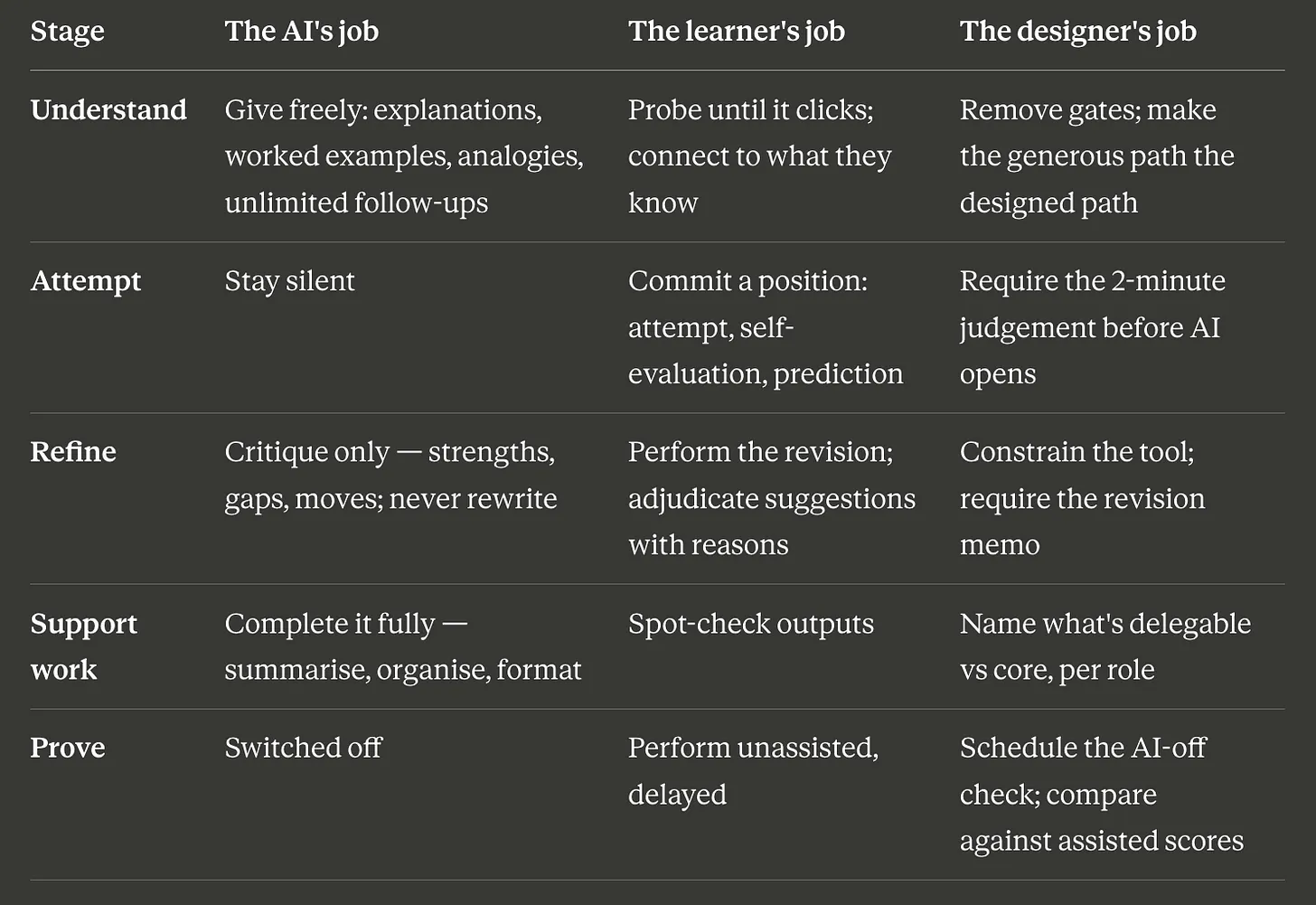
A new study shows AI helped deliver 1.5 years of maths progress in 8 weeks — here’s how. — from linkedin.com by Dr. Philippa Hardman

…a new study shows AI helped deliver 1.5 years of maths progress in 8 weeks — here’s how.

Google DeepMind just shared the results of a randomised trial involving 1,763 students. Half used Gemini’s “Guided Learning” to learn maths; half didn’t.

The result: the group working with AI gained the equivalent of 1.2 to 1.7 years of extra progress compared to those who didn’t.

It’s tempting to read this as “Gemini’s Guided Learning mode works!” But the key point here is that Gemini didn’t work alone….

Look closer, and what made the difference wasn’t just the tech — it was a great teacher making expert use of it.


The Tyranny of College Admissions: Why It’s So Challenging to Have Real Change in K-12 Education — from gettingsmart.com by Jon Alfuth

Key Points

  • College admissions policy shapes K-12 practice. If colleges continue to privilege course sequences, seat time, and grades, high schools will remain constrained in how far they can move toward competency-based learning.
  • States and institutions already offer models for change. Wisconsin, Colorado, Indiana, and pilots like CUNY and Michigan Ross show that admissions can incorporate portfolios, demonstrations of learning, and durable skills.

If we could instead orient K-12 education around skill development and application rather than Carnegie Units and grades, we could create a new paradigm for where, when and how students demonstrate college and career readiness. Competency-based education moves schools and systems towards this desirable future that balances knowledge with skills. 

Despite tremendous evidence of its potential, efforts to accelerate this shift have been stymied by the tyranny of college admissions requirements and processes. Parents, teachers, administrators and policymakers end up in a quandary. Anyone attempting to shift away from this traditional course sequence is criticized as trying to lock kids out of higher education and we snap back to the way things have always been done. 


Why Students Aren’t All In on AI—And What They Want From Colleges — from insidehighered.com by  Colleen Flaherty
New Student Voice data reveal students are embracing AI as a learning tool while worrying about dependence, career disruption and inconsistent institutional responses.

Read on for six takeaways from the survey and additional insights—including how institutions can start to close the gap between students’ optimism about AI as a learning tool and their faith in their colleges’ ability to help them navigate change.

Takeaway 1: More students are using AI than ever for coursework, while a significant share—20 percent—remain resisters.

Takeaway 2: “Worried about dependence” is the most common student stance on AI.

Takeaway 3: A majority of all students expect AI to somewhat (39 percent) or very (16 percent) negatively impact their career prospects.

Takeaway 4: Just one in 10 students says that their institution is handling AI’s rise very well, in a thoughtful and proactive way.

…and more >>


American Microschools 2026 Sector Analysis — from microschoolingcenter.org

The National Microschooling Center just published its latest report, the American Microschools 2026 Sector Analysis, it’s most ambitious yet.

This report comprises the most thorough research published to date on microschools in America, examining 1,000 microschools located in all 50 states, the District of Columbia and Puerto Rico. Most are currently operating, with prelaunch microschools as well as those which have closed their doors also included.

This 2026 edition of the annual American Microschools Sector Analysis series by the National Microschooling Center includes questions on a number of new topics, including ways microschools are impacted by different regulatory and policy stipulations, specifics of educational, business and operational aspects within the microschooling sector. Other questions revisit topics examined in previous studies, to illuminate trends over time and effects of growth and evolution on the ways microschools operate.

 
© 2025 | Daniel Christian